
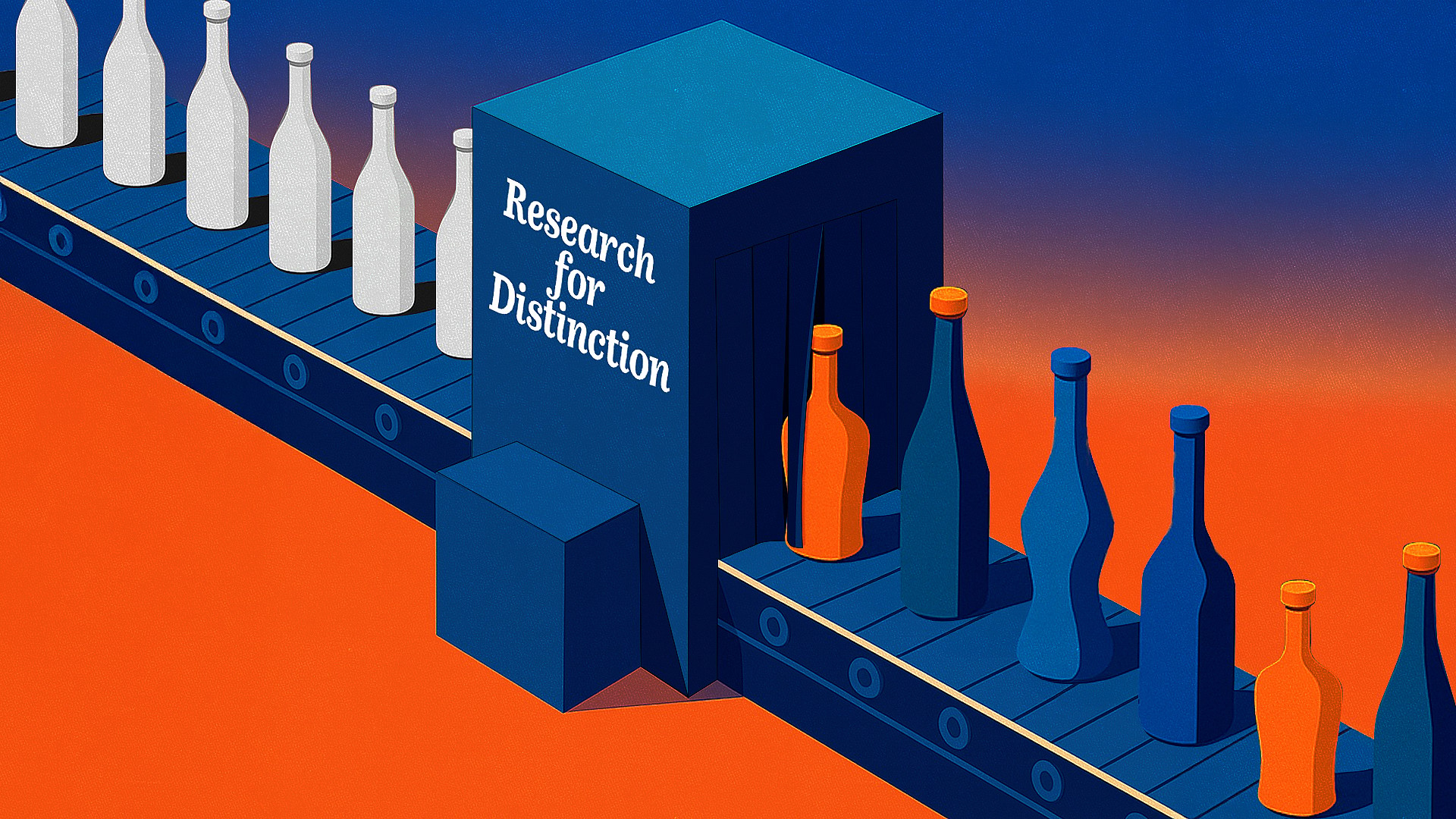
Stop wasting money on average branding. Make research a jumping off point, not a set of brakes.
In Part 1: Researched to Average, I outlined how our obsession with research is averaging everything to death. But the solution isn’t to abandon data, it’s to use it strategically.
The research itself is damning: half of ads trigger no emotion at all. Zero. Nothing. That isn’t just boring, it’s ruinously expensive. According to a System1 report, to lift the performance of those dull ads to the level of good work would cost an extra $189 billion in media spend!
And it’s not just ads. It’s the same story across the brand ecosystem, packaging, identity, websites, retail, everywhere. Average might be the most expensive mistake a brand can make. Especially as it costs the same to do great work as it does dull work in the first place.
So, how do you break free from researching everything to death?
Data Advises. Brand Decides.
We all naturally weigh the advice of people around us. The friend who shares your taste in movies, the colleague who knows the best new restaurants. And we know which people to ignore when it comes to holiday destinations or wine recommendations.
Yet in marketing, we build teams of experts who understand the product, the market, the competitive landscape, etc. Everyone works together to find creative solutions to the problems. We then research with a small group of strangers and weigh their opinions the most. It’s madness.
Customer insights should inform creative decisions, not dictate them.
Think of research as fuel for your creative brief, not a scalpel to dissect originality. Consider Guinness’ iconic “Surfer” ad. It received a wholly negative reception in pre-testing, but brave marketers pushed it through anyway. Today, it stands as one of the most groundbreaking and memorable ads of all time.
Or we could look at Tropicana. Back in 2009, they redesigned their packaging, ditching the distinctive orange with the straw, a symbol consumers didn’t just recognise, but felt. The new design looked modern, clean, rational even. And yet sales fell off a cliff, $30 million lost in just a few weeks. Why? Not because the design was bad for an orange juice, but because it’s just another orange juice like all the others. It was no longer distinctive, no longer a brand, no longer Tropicana. It was just average.
The solution isn’t to abandon data entirely. It’s to establish clear boundaries around what gets tested and what gets protected, how each of the inputs and opinions are weighted. If Pre-brief research clearly shows distinct white spaces or product attributes, they should carry more weight than a focus group’s opinion of a picture of a packaging design on the PowerPoint slide.
Start at the start.
All the best research is done before the creative ideas start flowing. Great background on the brand, the market, the consumer we want to connect with. How other categories are doing it. Legacy, dominant, and emerging trends and semiotics. All the inputs help unearth interesting ideas based on a truth.
Amazing research at the start means you can really understand the problem and find incredible, creative solutions unique to the brand, creating something distinctive that consumers find, understand, and love. It also enables everyone to live the brand, make smart brand decisions and give the confidence to weigh research on the creative correctly.
Brand first thinking.
There’s a simple way to keep things on track. We call it Connect in FULL. Found, Understood, Lived, Loved. It works as a brand filter for everything: packaging, campaigns, websites, touchpoints, the whole brand ecosystem.
FOUND — Is it distinctive? Will people recognise this as us in two seconds flat? That’s not just logos and colours. It’s the whole character of how you show up.
UNDERSTOOD — Is it story-worthy? Could someone explain it to a friend? Retell it in a sentence? That’s where simplicity and clarity beat cleverness.
LIVED — Is it on-strategy? Does it push the brand forward with intention?
LOVED — Does it create feeling? Not just: “I saw that.” But: “I felt that. I liked it. I want it.”
If it doesn’t connect, it shouldn’t go out, a balance of logic and magic. Use research to inform. Use the brand to decide.
Build Bravery into the System
It’s not enough to say “we want brave work.” You have to back it. It means giving teams permission to polarise. Strong brands attract and repel. Bland brands do neither. You may want to set failure budgets. Ring-fencing a percentage of your spend for ideas that might not work.
And it certainly means fighting against:
Averaging: Copying what seems safe because it’s been tested by someone else.
Over-optimisation: When everything has to work everywhere, it ends up looking like nothing.
Performance tunnel-vision: Obsessing over short-term numbers and forgetting the long game.
Procurement squeeze: Cutting budgets until there’s no room left for the details that make work great.
These things creep in quietly. It’s our job to spot them and push back.
Why It Matters
Distinctiveness isn’t about ego. It’s not about awards. It’s about giving your brand a real, defensible edge.
When a brand is distinctive, it doesn’t just sell better. It becomes easier to find, easier to remember, easier to love. You save money on media, hold shelf space longer, and get talked about.
When everything looks the same, price is the only thing left to compete on. And that’s a race no one wants to win.
Time to Connect
Distinctiveness isn’t just about getting noticed; it fuels every stage of the customer journey: Found → Understood → Lived → Loved.
Average breaks everything. If people don’t find you, they can’t understand your value. If they don’t understand you, they won’t try you. If they don’t try you, they certainly won’t love you.
Distinctive brands, by contrast, create compounding advantages at every stage. They’re easier to find because they stand out. They’re easier to understand because their positioning is clear and consistent. They’re more likely to be tried because they generate curiosity and conversation. And they’re more likely to be loved because they feel like authentic expressions of human creativity rather than algorithmic outputs.
This is why distinctiveness pays dividends far beyond research effectiveness. It reduces acquisition costs, increases customer lifetime value, enables premium pricing, and builds defensive moats that competitors struggle to cross.
Final Thought
The goal isn’t to be reckless with research, it’s to be strategic about distinctiveness. Use data to optimise performance, but protect the creative vision that makes performance worth optimising in the first place. This isn’t anti-research, it’s pro-brand.
In the age of algorithmic beige, when AI can replicate any aesthetic and platforms reward conformity, your last legal unfair advantage is to be unmistakably you.
The brands that win won’t be those that perfect the average. They’ll be those brave enough to break from it. They’ll invest in systematically building distinctiveness into everything they do.
The choice is yours: research your way to expensive irrelevance, or differentiate your way to memorable market leadership.
Differentiate. Always differentiate.