
Why the smartest brands are designing for habits, not impressions
Your customers see your ad 47 times and forget you exist by Tuesday.
Nespresso customers perform a daily ritual.
Same category. Different religion.
The difference isn’t budget. It’s intention.
Most brands are trapped in the attention economy—buying impressions, optimising reach curves, celebrating awareness lifts that evaporate by quarter’s end.
Meanwhile, a quieter group of brands has built something more durable: they’ve become part of people’s routines. They don’t interrupt life. They’re part of it.
This isn’t about engagement. It’s about connection.
The Expensive Lie
Here’s the problem with attention: it’s rented, not owned.
You pay for it every time. You optimise for frequency because memory fades. You chase mental availability because out of sight means out of mind.
Byron Sharp taught us that distinctiveness and mental availability drive growth. He’s right—you need to be noticed, recognised, and bought at least once.
Mental availability gets you into the consideration set. Behavioural integration keeps you there.
The brands that win long-term aren’t just the ones people remember—they’re the ones people do without thinking.
Think about your morning.
You don’t “consider” your coffee routine. You don’t “evaluate” your commute podcast. You don’t “browse” your workout app.
You just do them. Automatically. Effortlessly.
The brands embedded in those moments aren’t competing on recall—they’re competing on irreplaceability.
The functional food and beverage market is projected to double from $398 billion in 2025 to $793 billion by 2032. But the growth isn’t coming from new ingredients or clever messaging. It’s coming from products that fit into routines—morning tonics, post-workout drinks, evening wind-down rituals.
These brands aren’t just selling outcomes. They’re selling repetition.
And repetition builds religion.
Rituals Are Designed, Not Discovered
We like to pretend some rituals are “natural”. They’re not. Many were engineered.
Take brushing your teeth.
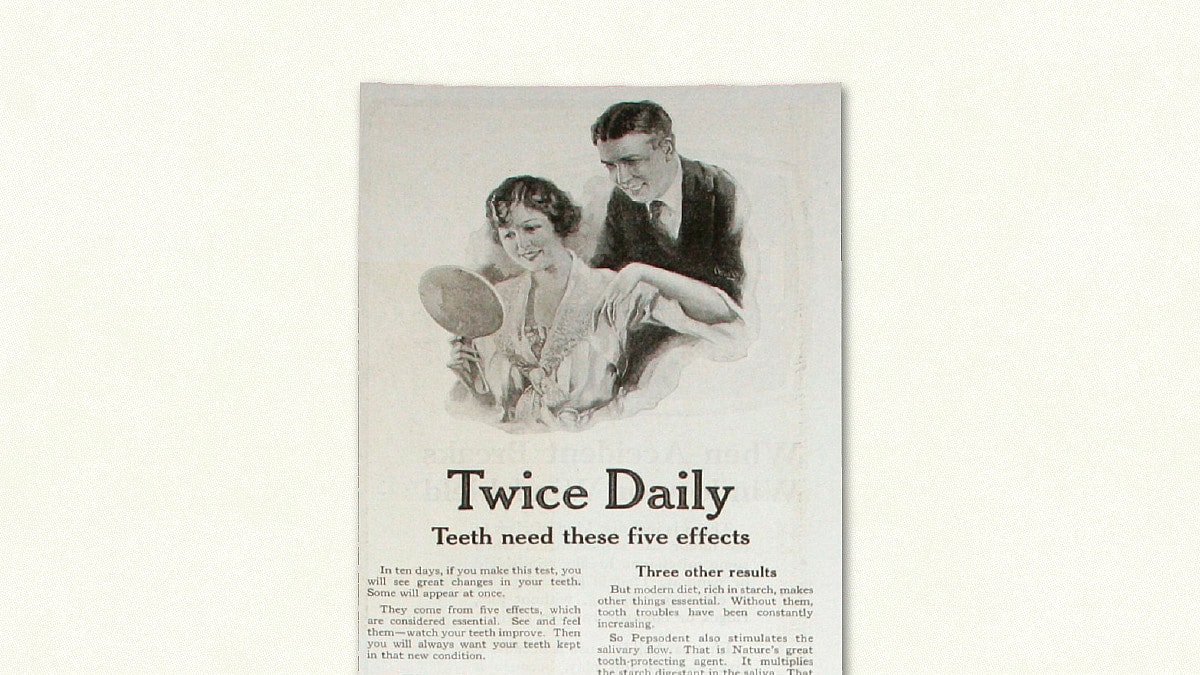
As Hacking the Human Mind points out, brushing twice a day wasn’t handed down from the heavens as universal wisdom. It was created to get people using toothpaste consistently.
Early toothpaste brands didn’t just shout benefits. They built a routine: morning and night, bathroom mirror, same motion, same sequence, same feeling of “clean” at the end. They attached a product to a specific time, place, and identity: I’m a modern person who looks after my teeth.
Over time, the ritual outlived the advertising. The behaviour became culture. An entire category now lives off that tiny piece of behavioural architecture.
That’s the power you’re playing with.
You’re not just fighting for attention in the bathroom aisle. You’re fighting to own a square of the bathroom.
You see the same pattern everywhere once you look for it.
“One chew after dinner” turned dog dental treats into a nightly ritual.
“Five-a-day” turned fruit and veg into a daily score.
These aren’t campaigns. They’re scripts for daily life.
Inside the Ritual, But Still Replaceable
Now look at coffee.
Starbucks hasn’t lost the morning coffee occasion. But as the chain scaled and optimised for speed, the third space ritual flattened into “caffeine, fast”. Any drive-through could deliver that. Customers kept buying, but they also stopped caring.
It’s a death spiral most brands don’t see coming. You can be part of someone’s day and still be completely replaceable.
So Starbucks leaned into more deliberate, functional choices—protein cold foam, custom combinations, seasonal “this is my order” rituals. Not just as product innovation, but as ritual anchors.
Your coffee now does something beyond caffeine. It’s fuel. It’s a tiny act of self-authorship. It’s a reason to choose Starbucks specifically, not just whoever’s nearest.
That’s brand thinking, not barista thinking.
You see the same challenge across categories. Morning newspapers, appointment television, weekly grocery runs weren’t disrupted by slightly better competitors. They were displaced by ambient alternatives. Convenience killed ritual. Algorithms replaced intention.
The brands that survive are the ones rebuilding deliberate, repeatable moments.
-
The pet brand that owns “treat, teeth, bed” every night.
-
The skincare brand that turns a three-step routine into “how I reset my day”.
-
The maternal health brand that turns “have a tea” into “I’m actively taking care of myself and my child”.
Not just products. Practices.
The Missing Layer
Most brand frameworks stop too early.
They help you get Found—distinctive, noticed, remembered.
They might help you get Understood—clear positioning, meaningful difference.
But they don’t help you get Lived.
That’s the missing layer. The stage where brands stop being things people know about and start being things people do.
Mental availability asks: “Will they think of us?”
Behavioural integration asks: “Will we become part of their lives?”
The gap between those two questions is where billion-dollar moats are built—or lost.
In our language, this is the “Lived” in Connect in FULL: the point where the brand leaves the deck and enters the day.
How Rituals Actually Work
Rituals aren’t magic. They’re behavioural architecture. And they solve three problems ads can’t.
1. They eliminate decision fatigue.
Every choice costs energy. So the brain automates whatever it can.
When a brand becomes part of a ritual, it stops being a choice and becomes a given. You don’t decide whether to brush your teeth or make coffee. You just do.
If Nespresso is the machine on your counter, or your brand is the toothpaste at the sink, you’re not competing for consideration—you’re embedded in real life.
2. They signal identity.
People don’t buy products. They buy versions of themselves.
“I’m the kind of person who starts the day with a green smoothie.”
“I’m the kind of person who tracks my recovery.”
“I’m the kind of mum who looks after herself during pregnancy.”
Rituals are performative, even when no one’s watching. They’re how we reassure ourselves we’re living the life we claim to want.
In Korea, Daesang WellLife understands this. They don’t just sell functional tea. They sell maternal care—precision-blended teas for women before, during, and after pregnancy.
The ritual isn’t drinking tea. It’s taking care. The product is the vessel. The ritual is the brand.
3. They create compound loyalty.
Loyalty programmes reward past behaviour. Rituals create future behaviour.
Every repetition deepens the neural pathway. Every day you do the thing, it gets easier to do it tomorrow.
Brands that become part of that compounding don’t need to buy loyalty. They’ve built it into the user’s operating system.
How to Design Rituals (Not Just Products)
If you want to move from the attention economy to the ritual economy, stop thinking only like a marketer and start thinking like a behavioural designer.
1. Anchor to a trigger.
Rituals need a cue: time, place, or emotion.
Morning coffee. After-school snack. Post-walk dog routine. Evening wind-down.
The trigger tells the brain, “this is when we do the thing.” The best brands don’t just show up in these moments. They define them.
2. Reduce friction to zero.
Every step between intention and action is a reason not to do it.
Rituals work because they’re effortless. The capsule clicks in. The chew is in the jar by the door. The drink is already chilled in the fridge.
Subscription models aren’t just business models—they’re ritual enablers. The decision was made once. Now the behaviour just happens.
3. Build sensory signatures.
Rituals are embodied.
The hiss of the espresso machine. The snap of the blister pack. The foaming of the toothpaste. The crinkle of the treat bag.
These aren’t just brand assets. They’re behavioural cues. They tell your brain, “this is the thing we do now.”
4. Layer meaning over function.
Functional benefits get you in. Emotional meaning keeps you there.
Under Armour’s work with regenerative label UNLESS created plant-based performance gear designed to return safely to soil. The kit performs. But wearing it says, “I care about performance and the planet.”
The ritual of training becomes the ritual of living intentionally.
Strip the meaning out, and you’re back to commodity.
The Test
Most brand strategy starts with the wrong question.
“How do we increase awareness?”
“How do we improve recall?”
“How do we stay top of mind?”
These are attention-economy questions. They assume the problem is visibility.
But visibility doesn’t build moats. Irreplaceability does.
The right question is this:
If your brand disappeared tomorrow, would anyone’s day feel different?
Not “would they notice?”
Would their routine break?
If the answer is no—if they’d simply switch to the next option without friction—you’re not in their ritual. You’re in their consideration set.
And consideration sets are where brands go to compete on price.
The attention economy taught us to think in reach and frequency. Impressions and recall. Campaign cycles and media plans. It gave us tools to measure visibility.
But visibility isn’t the same as vitality.
The ritual economy asks different questions.
Not “Did they see us?” but “Do they need us?”
Not “Are we top of mind?” but “Are we part of the day?”
Not “Can they recall us?” but “Would they miss us?”
Rituals compound. Every repetition deepens the groove.
The brands embedded in those rituals aren’t competing on awareness—they’re competing on irreplaceability.
That’s the moat.
Not what people remember. What people do.
⸻
Being found, understood, lived and loved throughout the brand ecosystem has never been so important. Connect in FULL®