

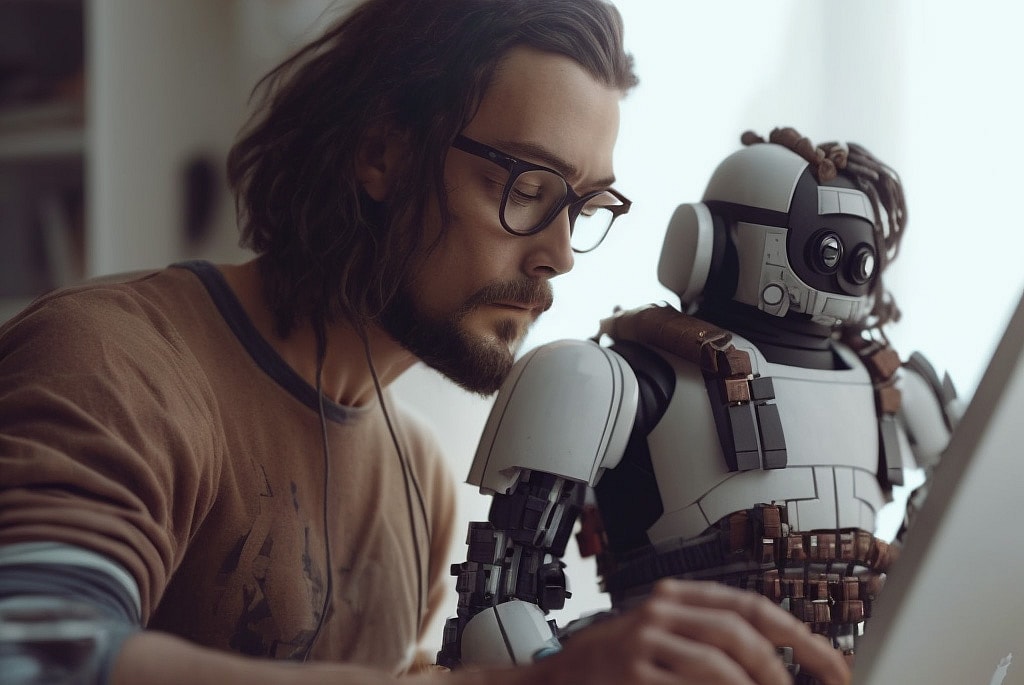
Microsoft recently unveiled its A.I.-enabled products, striking the perfect chord with the name: Copilot. This well-chosen name captures the essence of A.I. tools in the market, serving as our digital sidekicks to enhance productivity and streamline work processes.
A.I. can potentially reshape the world as profoundly as globalisation or the advent of computers. By amplifying productivity, A.I. can fuel economic growth across society. However, much like how globalisation and automation upended blue-collar work, A.I. is set to disrupt white-collar jobs. The question is: will the new generation of white-collar Luddites be as willing to retrain? perhaps as plumbers? After all, there can never be enough plumbers!
“Augmented” or “assistive” intelligence might be better to describe the current A.I. landscape instead of “artificial.” Artificial is a stretch, but with the tech hype cycle in full effect, exaggeration is the name of the game.
While automation has long been a mainstay in numerous industries, A.I. is making inroads into creative fields. Research models once predicted that highly creative jobs would be least susceptible to automation. Although creative fields may be less affected, A.I. will undoubtedly have an impact.
A.I.-generated images, text, music or voices can undeniably save time and resources. It is a small leap to imagine a future where Google and Facebook offer fully A.I.-created campaigns on their advertising platforms.
However, the real value lies in the human touch—asking incisive questions, curating thoughtfully, and exercising creativity. The old adage of rubbish in, rubbish out applies to A.I. too. The A.I.s don’t care about the truth they are completely indifferent to it — the perfect bullsh*t machines.
Most of the current crop of A.I. are trained on data pre-2021. Even with new plugins and methods allowing A.I. access to current data, they will only understand and build upon the past. Genuine innovation and change spring from envisioning and bringing the future to fruition. Be it a new style, colour, or gadget.
As we stand on the threshold of a new technological era, predicting the extent of disruption A.I. will cause remains unclear. Nevertheless, it’s clear that A.I. will revolutionise the tools we use daily, making them more effective and efficient.
By enabling people to focus on problem-solving instead of busy work, A.I. can help us unlock time to be creative. Just as digital tools accelerated the creative process, A.I.’s potential lies in its capacity to enhance our creative processes and problem-solving abilities. Ideas have always been abundant, with execution the limiting factor as there is only so much time. A.I. may facilitate easier execution, allowing us to delve deeper into ideas and discover better solutions. Making ideas the differentiator, ideas will be king.
As we embrace A.I. in our professional lives, it’s crucial to remember that it is a tool designed to complement human creativity and ingenuity, not supplant it.
As always, the future is both uncertain and exciting.
Writing credits: Mike Foster, ChatGPT, Rytr.
Image credits: Mike Foster, MidJourney.