
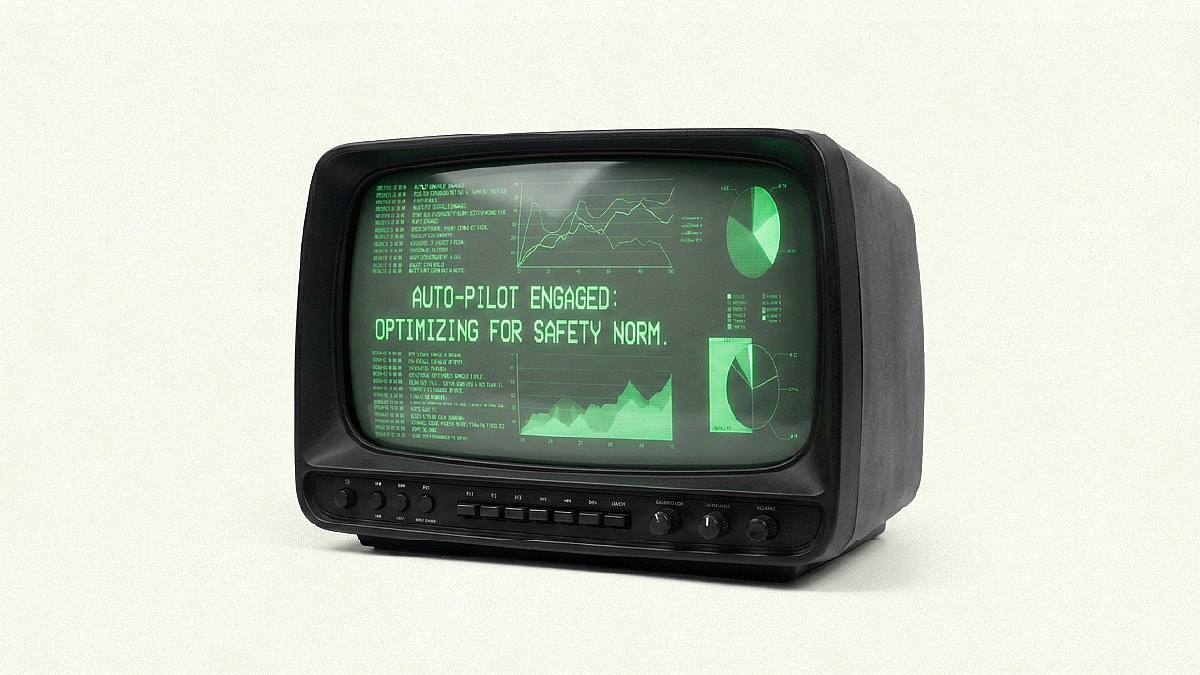
When the dashboards start driving, brands lose direction.
Modern organisations are drowning in fake decisions. Choices that sound meaningful but change nothing—optimised for safety, not belief. We’re confusing momentum with direction.
And brands are paying the price.
When research stops informing and starts steering
Research was never meant to lead. It exists to reduce blind spots, not remove judgment. To pressure-test ideas, not flatten them.
But today, many brand conversations don’t start with “What should we do?” They start with “What will the system approve? What will test well? What can we justify?”
Backing a chart is safer than backing an opinion. If it fails, you can always say you followed the data.
This is how leadership quietly becomes compliance. Not by design, but by default.
You can’t A/B test distinctiveness
Dashboards reward what’s immediate, attributable, and repeatable. Brands are built on the opposite: memory, meaning, and distinctiveness.
You can’t A/B test belief. You can’t model distinctiveness before it exists. When metrics become the primary decision-maker, conviction gives way to iteration.
Liquid Death: If Mike Cessario had optimised for “safety” or “category norms,” research would have killed the name, the tall-boy can, and the heavy-metal aesthetic before they ever hit a shelf. Instead, he relied on conviction to create a brand that is instantly recognised and fiercely loved—because it refused to be beige.
Nobody chooses beige. They optimise their way into it.
The Brand Auteur advantage
Software is brilliant at optimisation. It’s terrible at orientation. It can tell you how to do something better. It cannot tell you what’s worth doing at all.
The film industry figured this out a century ago: someone has to be the director.
In the age of AI and short-term optimisation, the Brand Auteur—someone whose taste sets the ceiling—is becoming more valuable, not less. The brands that stay distinctive won’t be the most optimised. They’ll be the most convicted.
The accountability vacuum
Fake decisions thrive because they dilute responsibility.
“No one chose this.” “The model suggested it.” “The research supported it.”
If everyone is in charge, no one is.
Brands need owners, people willing to say “this is the call,” especially when it can’t be enumerated. Not everything that counts can be counted.
Install conviction as a discipline
This isn’t an argument against data. It’s an argument for keeping humans in the loop with authority.
Use research to sharpen choices, not neutralise them. Use data to inform judgment, not replace it.
It’s why founder-led brands often have an advantage.
So name a Brand Auteur. Every brand needs someone empowered to protect distinctiveness and say “this is who we are,” even when the dashboard disagrees.
When brands let systems drive, they don’t crash dramatically. They just slowly forget where they were going.
Make Brand Decisions
Before signing off your next “decision,” ask:
- What are we rejecting?
- What new thing exists because of this?
- Could this fail?
If you can’t answer those, it isn’t a decision. It’s motion.
And brands don’t win by moving. They win by meaning it. By making meaningful Brand decissions.