

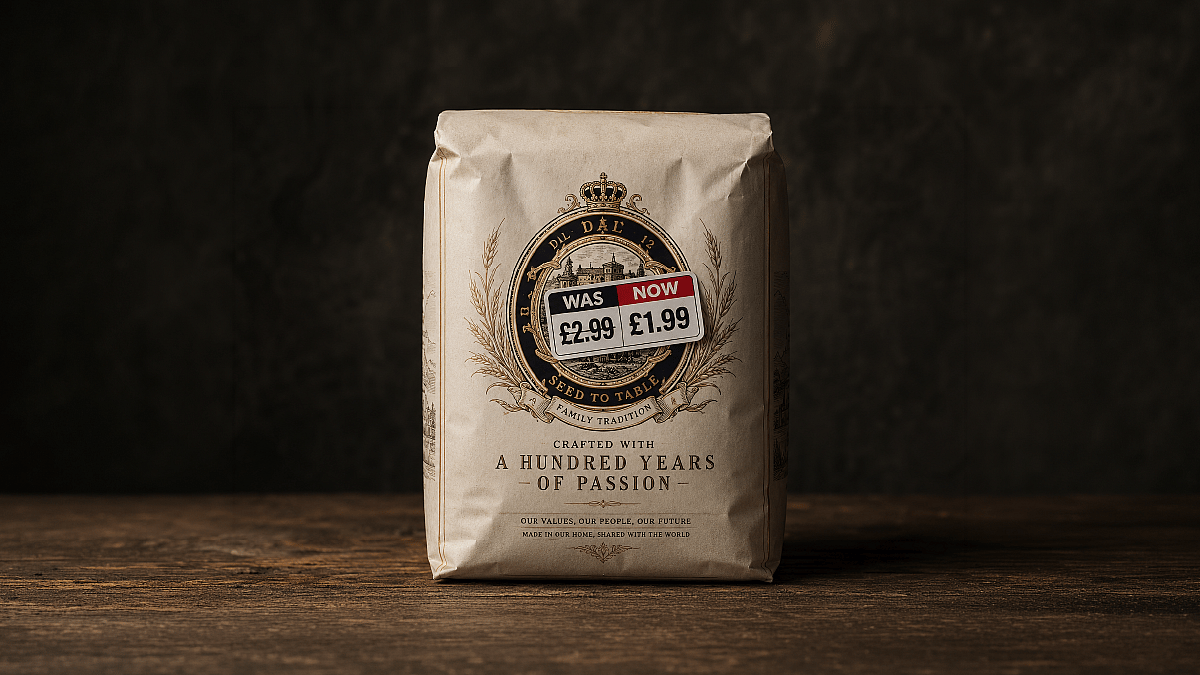
Why “better and cheaper” fails at the border.
At home, your price is read against your memory — the mill, the town, the years on the shelf. Abroad, your meaning starts at zero, so price becomes the only thing anyone can read.
That’s the problem with being better and cheaper. It sounds unbeatable in a boardroom. It lands as neither on a shelf.
The exporter’s trap
Every heritage brand tells itself the same story at the departure gate: we’re better than what they’ve got, we’ll price under the leader to earn trial, the quality will do the rest.
It sounds sensible. Commercial. Low-risk.
It’s a factory truth, not a shopper truth.
Inside the business, everyone knows why the product is better — the source, the craft, the standards, the history. The shopper in the new market knows none of it. They didn’t grow up with the brand. They can’t taste the pack from three feet away. They have two signals: what it looks like and what it costs. And in a category where they already trust a leader, “cheaper than the brand I know” doesn’t read as generous. It reads as lesser.
A hundred years of meaning, priced like an apology.
The lager that charged more for being ordinary
In Belgium, Stella Artois was an unremarkable everyday lager. In the UK it cost more — higher duty on a stronger brew. A weakness, on paper. A reason to explain, discount or apologise.
Instead, the brand made the price the message. Reassuringly Expensive ran from 1982 to 2007 and helped quadruple the business over two decades. Same liquid, different country. The premium wasn’t inherited from home — it was built for the market it landed in.
The lesson isn’t “charge more.” It’s that Stella knew it was starting from zero, chose the one signal a stranger reads instantly, and made everything else agree with it. It didn’t let the market decide what the price meant. It told the market what the price meant.
The pasta that refused to discount
Barilla entered the US in 1996. It didn’t price under Mueller’s, the incumbent, to earn trial. It arrived in its blue box, said one thing — Italy’s #1 pasta — priced at a premium, and put 10% of sales behind saying it. Three years later it wasnumber one.
One claim. One box. A price that agreed with the story instead of arguing with it.
Meaning doesn’t travel. Signals do.
Neither brand exported its story. Stories are slow — they take a generation to soak in at home and they don’t fit on a facing. What crosses the border is a signal: one claim, one distinctive asset, one price that says the same thing the pack says.
At home, a heritage brand is loved — decades of rituals doing the work. Abroad it hasn’t been found yet, and you can’t be understood in a market where you’ve never been found. Love doesn’t clear customs. You start again — deliberately, or by accident.
Deliberately means choosing the signal you want the new market to read first, and making pack, price, claim and channel tell the same story. By accident means whispering your history while shouting “cheaper.” Shouting wins.
The cost of the first read
There are moments when a lower price is the right move. But too many brands confuse pricing for access with pricing as meaning. They think they’re lowering the barrier to trial. The shopper thinks they’re lowering the standard.
That gap is expensive. Once a brand arrives as the cheaper alternative, it has to work twice as hard to become anything else. The first read sticks. The shelf teaches quickly. And once the market has decided you’re the value option, your heritage becomes decoration — a crest, a date, a family name nobody has time to decode. Not meaningless. Unread.
The problem isn’t that the story is weak. It’s that the signal is stronger.
The test
If your brand is crossing a border — or already has — stand in front of the shelf and ask one question:
What does the pack say to someone who’s never heard of us, at the price we’ve chosen?
Not what it says to you. Not what it says at home, where every curve and crest carries forty years of memory. What does it say cold, in three seconds, next to a leader they already trust?
If the pack and the price tell different stories, the price wins. It always wins. Price is the only part of the brand a stranger can read fluently on day one.
Better and cheaper isn’t a position. It’s two claims cancelling each other out.
Pick the signal. Price like you mean it. Then let the story catch up.