
Thoughts from Expo West 2026
At one point during Expo West, I overheard a conversation that perfectly captured the state of the food industry.
A man was standing at the Belgian Boys stand, looking at a waffle.
“But what does it do?” he asked.
“It’s a waffle,” the team replied. “You eat it.”
“Yes, but what does it do for you?”
“You eat it. It makes you happy.”
“So it’s not functional?”
“No. It’s a waffle.”
The waffles, by the way, were excellent.
But the exchange stuck with me because it captured a tension running through the entire show floor.
When did a waffle stop being enough?
The Proteinisation of Everything
If you walked Expo West this year, one trend was impossible to miss.
Protein.
Protein jam. Protein bread. Protein popcorn. Protein coffee.
Almost every category had been upgraded with extra protein.
What’s interesting is that science isn’t necessarily driving this trend.
In the UK, most nutrition experts believe the average diet already contains enough protein. Fibre is the nutrient many people are actually missing.
But protein has become something else entirely.
It’s a signal.
Protein tells consumers this product is serious about health. This product fits an active lifestyle. This product earns its premium.
Protein is no longer just an ingredient.
It’s a marketing language.
The Functional Food Arms Race
Protein is only one part of a broader shift.
Expo West revealed an industry moving rapidly toward food as functionality. Products promising energy, focus, gut health, sleep support, longevity. Food is starting to look more like a supplement aisle.
In theory, that makes sense. People want to feel better. Nutrition science is improving. Brands want to offer real benefits.
But something else happens when every product promises performance.
Joy quietly disappears.
The Return of Old Ingredients
Another striking signal across the show floor was the rise of beef tallow.
The American backlash against seed oils continues, and many brands are leaning into traditional fats as a more natural alternative.
This reflects a wider pattern. Consumers increasingly trust ingredients that feel older, simpler, less industrial.
The message isn’t just about nutrition.
It’s about authenticity.
People want food that feels closer to farms than factories.
When Natural Becomes Normal
Expo West also made something else clear.
Natural food is no longer niche.
The US natural products sector now exceeds $300 billion. What once felt like a challenger movement has become the industry itself.
And yet 40% of consumers still don’t understand what “natural and organic” actually means. That stat, shared by Acosta’s president Ashley Roehm during a keynote, stopped me.
The industry is building claim upon claim, certification upon certification, for an audience that still hasn’t understood the basics.
That creates a real challenge for brands.
If everyone is natural, everyone is functional, and everyone has protein, what actually differentiates you?
The instinct is to say more. Add another claim. Stack another benefit.
But saying more doesn’t make you clearer.
It makes you easier to ignore.
Distinctiveness in the Wild
One of the most visible brands at Expo West wasn’t a product at all.
It was a bag.
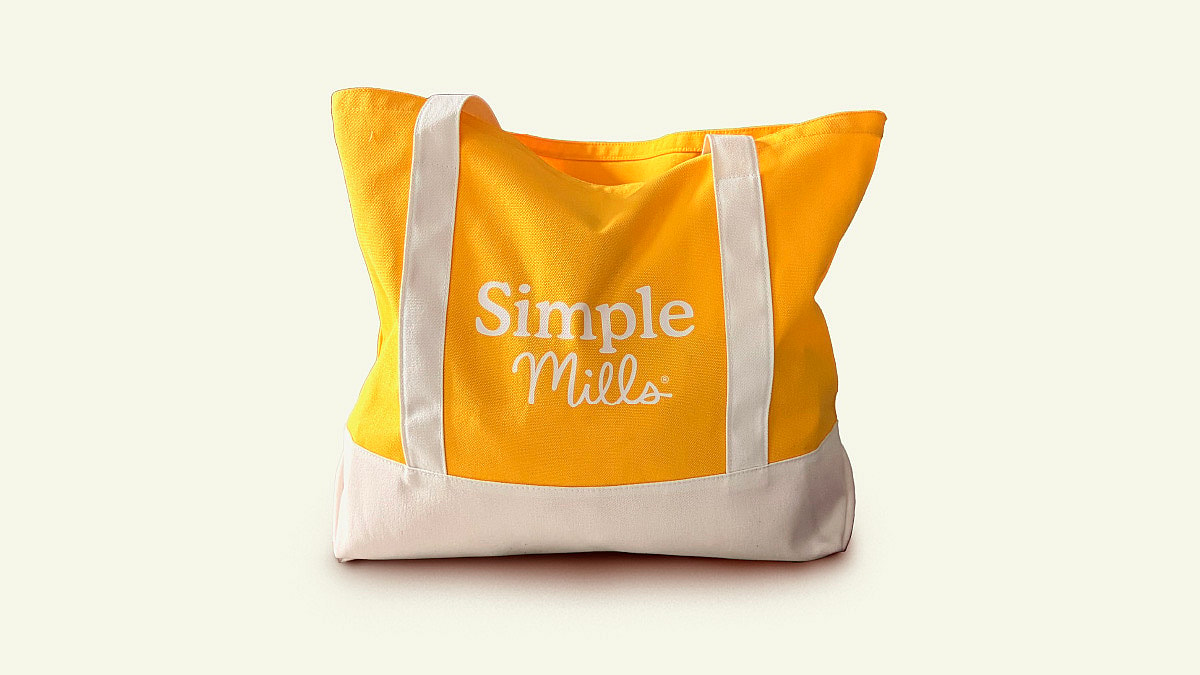
The bright yellow Simple Mills tote was everywhere. Across the show floor, attendees were carrying them between halls, turning themselves into walking billboards.
It’s a small thing, but it illustrates something important.
Distinctive brand assets travel.
They move across environments you don’t control and still trigger recognition. That’s how brands become easy to find in busy environments. And being found is where brand growth starts.
At a show that felt like sensory overload, thousands of booths competing for attention, distinctiveness mattered more than ever.
The Rise of Regenerative
Another encouraging trend was the growing presence of Regenerative Organic Certified products.
Just a few years ago, regenerative agriculture was a niche conversation. At Expo West, it’s starting to become a visible trust signal.
That shift matters.
Natural food was once defined by what it avoided. No artificial ingredients. No preservatives. No chemicals.
Regenerative flips the narrative.
Instead of avoiding harm, it signals active improvement. Restoring soil, ecosystems and farming systems.
That’s a much stronger story.
The Sensory Overload of Innovation
Expo West is enormous. This was my first time attending.
My Apple Watch recorded 87 kilometres of walking during the week, and I still only saw a fraction of the show. 3,300 brands. 60,000 people. Thousands of booths. Endless samples. Every brand trying to stand out.
It’s exhilarating and exhausting in equal measure.
But here’s what I keep coming back to. Expo West isn’t just a trade show. It’s the most honest simulation of what consumers experience every day.
Twenty thousand products in a supermarket. Decisions made in under two seconds. Overwhelming choice. Limited attention. Zero patience for complexity.
If I, a brand strategist who does this for a living, couldn’t remember most brand names after day one, what chance does a shopper have in a supermarket aisle?
Charlie New, Amazon and Whole Foods’ worldwide grocery category manager, put it perfectly at the show: brands consistently overestimate the knowledge and time consumers have when shopping in-store.
He’s right.
And the show floor proves it.
Because in that chaos, the brands that stick with you aren’t always the most scientifically advanced.
They’re the ones that feel human.
A great espresso from Counter Culture Coffee. A conversation with a founder who believes deeply in their product. A waffle that simply tastes fantastic.
The Real Question
Expo West left me with a question that feels bigger than one trade show.
Are we turning food into a system of optimisation?
Or is there still room for simple joy?
Because when every product promises performance, food risks losing something fundamental.
Food isn’t just fuel.
It’s pleasure.
It’s ritual.
It’s culture.
And sometimes the best thing a product can do is exactly what that waffle did.
Make you happy.
What This Means for Brand Leaders
If you work in food and beverage, Expo West offers three clear lessons.
Functional claims are becoming table stakes.
Protein and performance benefits are spreading into every category. They may soon be expected rather than distinctive.
Authenticity is gaining power.
The resurgence of traditional ingredients and regenerative farming reflects a deeper desire for food that feels real.
Differentiation will increasingly come from brand, not formulation.
When every product claims benefits, the brands people remember will be the ones that feel meaningful, distinctive and human.
And here’s a practical test.
Before you sign off your next innovation, rebrand or campaign, ask four questions:
Found — Could someone spot my brand in under two seconds, without relying on the logo?
Understood — Could someone grasp what my brand is about in a single glance?
Lived — Does my brand show up consistently wherever it lives: shelf, screen, feed, conversation?
Loved — When was the last time my brand did something that made someone smile and tell someone else?
If the answer to any of those is no, you don’t have a product problem.
You have a connection problem.
And no amount of functional claims will fix it.
Because sometimes a waffle doesn’t need to do anything more than be a waffle.