
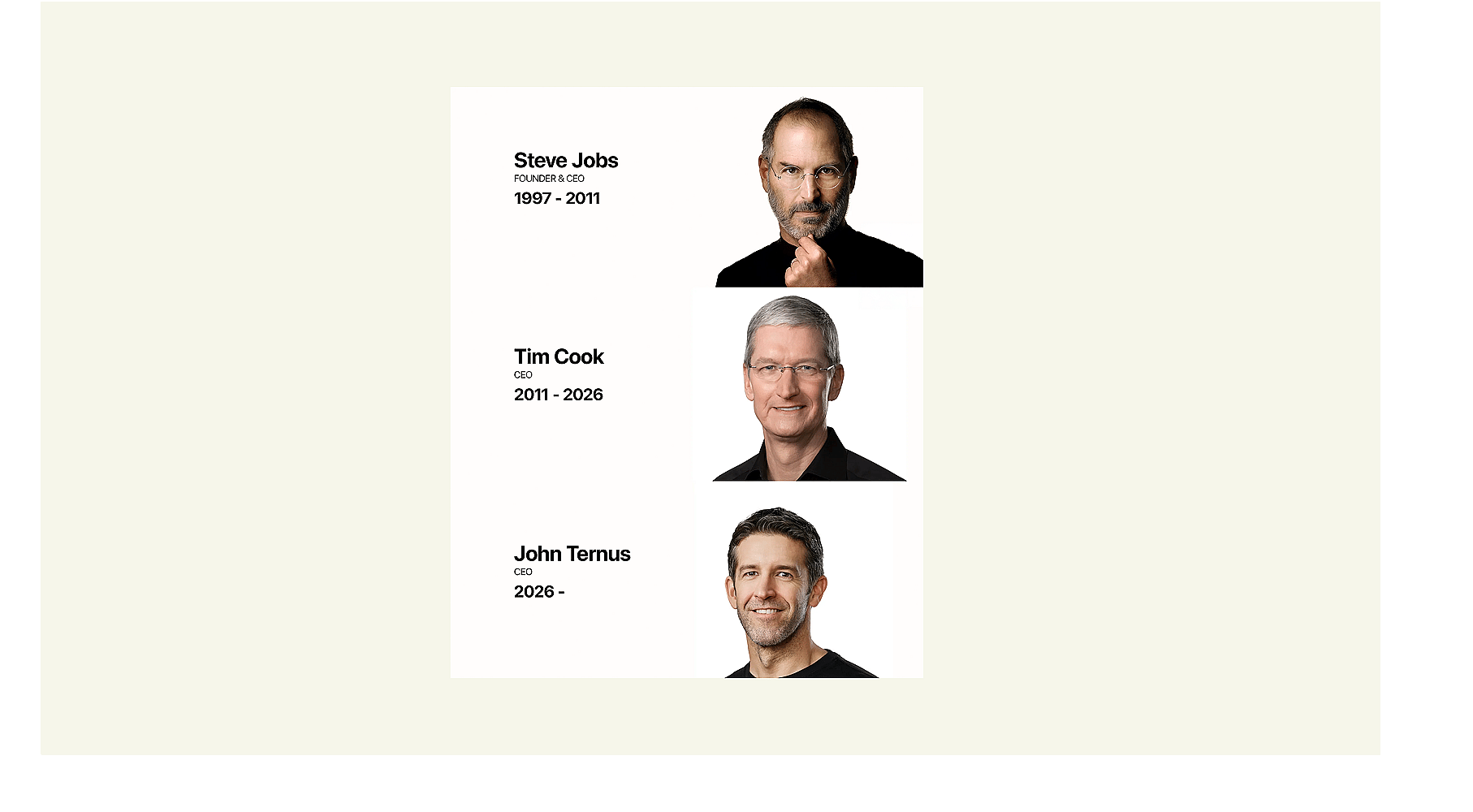
The founder who rebuilt meaning. The operator who scaled it. And the leader who has to choose what Apple protects.
Two Numbers, Two Stories
Tim Cook grew it 10× in 15 years.
But Cook added $3.47 trillion in market value. Jobs added $376 billion.
Same company. Two completely different stories, depending on which number you reach for.
The percentage tells you who rebuilt belief. The dollar figure tells you who scaled it.
Both are extraordinary. But they are not the same kind of extraordinary. And which one you instinctively reach for says a lot about how you think about leadership.
On Monday, Apple announced that Tim Cook will become executive chairman on September 1st and John Ternus will take over as CEO.
The business press is already writing Cook’s financial eulogy. Fair enough. The numbers demand it.
But there is a more useful question now:
What kind of decisions did each CEO reach for first? And what kind will Apple’s next one choose when it matters?
Steve Jobs: Meaning Before Margin
When Steve Jobs returned in 1997, Apple was in trouble. The company had lost over $1 billion, the product line had sprawled, and the brand had drifted. Apple did not just need better operations. It needed a reason to matter again.
Jobs’ first real move was not expansion. It was reduction.
Fewer products. Sharper focus. Clearer intent.
That sounds operational. It was. But it was also brand leadership. He was not just cutting complexity. He was restoring meaning. Apple had to stand for something again before it could scale anything. By 1998, the company had swung to $309 million in profit — not because Jobs found new revenue, but because he found Apple’s meaning again.
Then came the sequence that rebuilt the company.
The stores gave Apple control over how the brand was encountered and explained. The iPod moved Apple from computers into culture. The iPhone fused hardware, software and service into something people had never seen before.
And crucially, Jobs did not talk about these products like an engineer trying to win an argument.
“1,000 songs in your pocket.”
Not storage. Not specs. Not technical superiority.
A simple human value exchange.
That is what brand-led leadership looks like. It does not ignore business discipline. It puts it in service of a bigger idea.
Jobs made decisions that protected the feeling first. The commercial upside followed.
That is the founder advantage. Founders do not usually need a framework to make brand decisions. Their conviction is the framework.
Tim Cook: When the Engine Starts Leading
Under Cook, Apple made privacy a public value claim. It pushed accessibility forward. And under his leadership, Apple reduced its carbon footprint by more than 60% below 2015 levels — during a period in which revenue nearly doubled. Not emissions reduced while standing still. Emissions slashed while the business doubled. Proof that brand decisions and business outcomes do not have to be in tension. They can run in parallel.
These were not neutral management choices. They were meaningful calls about what Apple believed it was building.
And commercially, Cook’s record is extraordinary. He scaled Apple into one of the most powerful businesses ever built. That is not a small thing. Most leaders never come close.
But scale changes the centre of gravity. And over time, Apple’s centre of gravity appears to have shifted.
With Jobs, business discipline served the product story. With Cook, brand strength increasingly served the economic engine.
Same ingredients. Different order.
And order matters.
The clearest example is the App Store.
When Apple launched it in 2008, the relationship felt generative. Developers made the platform more valuable. Apple gave them distribution, trust and access to users. Steve Jobs positioned the 30 percent commission as the cost of running the store. A fair deal for the people who made the ecosystem valuable.
By 2011, Phil Schiller — Apple’s own marketing chief — sent an internal email asking whether Apple should rethink the split once App Store profits hit $1 billion a year. Should it be 75/25? Even 80/20?
That was not really a pricing question. It was a relationship question. What do we want our partnership with developers to feel like?
Cook chose to protect the margin.
Over time, that choice became visible. In 2025, a federal judge found that Apple’s response to anti-steering rules was “the most anticompetitive option” available — imposing a 27 percent commission on purchases made through external links, making those transactions more expensive for developers than staying inside the App Store. The matter was referred for possible criminal contempt investigation.
And then came the moment where the cost became undeniable.
When Jobs launched the App Store, developers rushed in. The excitement was obvious. They could not build fast enough. When Apple launched the most ambitious new platform of Cook’s tenure — the Vision Pro — that energy was not there. Apple’s biggest new platform in years did not inspire anything like the same developer response. That is not just a product problem. It is a relationship problem.
Business decisions often look smart in the quarter. Brand decisions show their value over years. Apple gave us both inside a single tenure.
The same pattern shows up elsewhere. Services growth layered into experiences that once felt elegantly neutral. More prompts. More upsells. More monetisation pressure in places where Apple used to feel above that sort of behaviour. Each one is defensible in isolation. Together, they change the feeling.
And that is how brand erosion works. Not through one catastrophic betrayal. Through a series of perfectly reasonable decisions that leave the experience a little less generous than it used to be.
Then there is China. Cook built one of the greatest operating machines in corporate history. But the speed, scale and efficiency of that growth came with exposure. The steeper line upward came with a values trade-off. That does not make Cook foolish. Far from it. It simply shows the tension at the heart of modern leadership: the business can get stronger while some of the brand’s underlying permission quietly weakens.
John Ternus: The Leadership Test That Matters
John Ternus is not walking into a turnaround. He is inheriting one of the most valuable businesses in the world. The question is not whether he can run Apple efficiently. Apple is already efficient.
The question is whether he can restore balance.
That is what makes this moment interesting.
Ternus is product-rooted. He has spent 25 years inside Apple, close to the making, not just the machine. He worked under Jobs. He was mentored by Cook. Apple itself describes him as having “the mind of an engineer.” That does not guarantee anything. But it gives him a different starting instinct. And it means he has inherited both playbooks.
Apple does not need him to become a second Jobs. That is impossible and beside the point.
What it needs is something harder and more relevant: a leader who knows where not to optimise.
A leader who understands that not every friction point should be monetised. That developers are not just yield. That trust is not a soft asset sitting beside the business, but part of the business itself. That product conviction still matters more than platform extraction.
A better Apple under Ternus would not be nostalgic. It would be disciplined in a different direction.
It would ask: should we charge for this? Maybe. But first — should we? What does it do to the relationship? What feeling does it leave behind? Does this make Apple stronger, or just better at taking?
Those are brand questions. And Apple’s next era will be shaped by how often its new CEO reaches for them before the spreadsheet answers first.
That is the real handover. Not founder to operator. Operator to steward.
The Lesson Beyond Apple
The founder builds belief. The operator scales it. The next leader has to decide what is being protected: the system, or the meaning that made the system valuable in the first place.
That is the danger zone.
Because brand erosion does not announce itself in the metrics most operators are trained to watch. Revenue still grows. Margins still hold. The quarter still looks good. But underneath, something starts thinning. Goodwill. Trust. Advocacy. The sense that this brand is still on my side.
By the time that shows up in the numbers, it has usually been happening for years.
So the question for Apple, and for every leadership team making decisions inside a successful business, is not just what can be optimised.
It is this:
What are we protecting? Not margin. Not efficiency. What feeling are we protecting for the people who choose us?
What are we trading? Every business decision buys something in the short term. What does it cost over time?
And would someone with real conviction make this call? Not nostalgically. Practically. Would a leader trying to build belief choose this, or only a leader trying to harvest it?
That is the choice in front of Apple now.
John Ternus inherits a company with immense strength, enormous trust reserves, and a chance to prove that brand leadership and business excellence do not need to be opponents.
That would be the real achievement. Not preserving Apple’s value. Renewing the logic that created it.
Brands succeed when they’re Found, Understood, Lived, and Loved. Connect in FULL®.